| March 2000 Gramophone Classical Good CD Guide
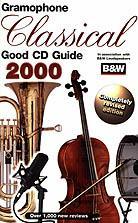
A completely revised edition, the 2000 Guide offers more than 1000 new reviews. It offers commentary on works by Adolphe Adam to Bernd Alois Zimmermann, and each review includes pricing information, recording date, format, pairings, label and catalog number, timing and performance data. At the rear of the book is a comprehensive review index and a listing, with contact information, of the recording labels found in the book. The latter item will be of considerably more value in Britain since only UK information is listed. At the front of the book, besides the usual abbreviation guide, is a guide to a basic classical-music library. Comprised of 200 items in 18 categories, the editors list works, wisely inviting you to browse the reviews in the book to create your own list of essential recordings. And, of course, it is the reviews that matter. Rather than attempting a comprehensive collection of all recordings, the Good CD Guide contains what could be called the essential reviews -- of the best recordings, of recordings made by most consistent, prolific and notable performers, and the classic historical recordings. This has two effects. First, it means that if a recording is listed, you can be assured that it has some value. For the beginning collector or the knowledgeable but less than obsessive, this makes the Good CD Guide indispensable. As a place to short-list the available recordings, it simply can’t be beat. Second, because it doesn’t list each and every recording, it is not the place to look up that obscure, war-era, radio bootleg of Furtwängler conducting the Beethoven 9th, the one released by three brothers working from their basement in Milan and burned on a CD-R with a handwritten label. For a select few, this will remove the Good CD Guide from the list of essential guide books, but since most of us need a guiding hand when moving into the very broad selection of classical recordings, the Good CD Guide falls into the indispensable if less than comprehensive category. The reviews themselves offer excellent insight into both the work and the performance, although there is little discussion between the reviews themselves. However, when more than one performance of a work is listed, the Good CD Guide marks the recommended performance. It also marks historical performances, and each Editor’s Choice (each monthly issue of the Gramophone magazine has ten such Editor’s Choice recordings) is also indicated. Finally, the Good CD Guide is very up to date, with reviews of releases right up to the end of 1999. What is missing from the Guide is the author of each review, which makes finding a reviewer to whom you relate impossible. I also wish that the symbols for recommended recordings and Editor’s Choice recordings were a bit larger. Beyond that, the layout of the book make for easy use, while the quality and timeliness of the reviews makes for easy reliance on the opinion therein. In summary, the Good CD Guide is not just a highly recommended guide to classical recordings for the beginner and intermediate classical-music fan, but an essential companion, one that should save you its purchase price with just a couple of wise choices. ...Todd Warnke GO BACK TO: |
 At the bottom of all we do
at SoundStage! lies music. After the gear, the tube rolling, the cable swapping and
the tweaking come the recordings. And for 77 years, Britain-based Gramophone
magazine has weighed in with opinions on just these, music recordings. In fact, as the
longest-running music-review magazine, Gramophone established the form and format
of classical-music commentary. And for a good many of those years they have released a
collection of reviews in book form, which brings us to the year 2000 issue of the Gramophone
Classical Good CD Guide.
At the bottom of all we do
at SoundStage! lies music. After the gear, the tube rolling, the cable swapping and
the tweaking come the recordings. And for 77 years, Britain-based Gramophone
magazine has weighed in with opinions on just these, music recordings. In fact, as the
longest-running music-review magazine, Gramophone established the form and format
of classical-music commentary. And for a good many of those years they have released a
collection of reviews in book form, which brings us to the year 2000 issue of the Gramophone
Classical Good CD Guide.